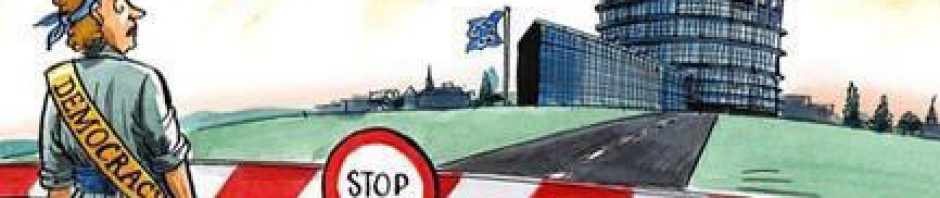
IMF

IMF lagarde

Pilt | Posted on by | Lisa kommentaar

Prelude to life in a Libertarian paradise

Tom Hickey viitab:

There you have it. The government requiring an employer to hang a poster informing workers of their rights is a violation of the employer’s liberty.

Employers requiring employees to attend a rally in support of Mitt Romney—or otherwise instructing employees how to vote in an election—is an exercise of the employer’s liberty.

Rights of Labor v. Tyranny of Capital

Corey Robin

Prelude to life in a Libertarian paradise, where ownership rights trump human rights and civil rights in world where those who own more are better than others owing to meritocracy.

Posted in Estonian | Lisa kommentaar

Valmistuge intressišokiks

Valmistuge intressišokiks

MMT sõbra võtab muigama selline artikkel Äripäevas Romet Kreegilt:

Eluasemelaenu võtnuile on kasulik teadvustada, et mingil ajal tulevikus kulub laenuintressi­makseteks senisest kordades rohkem raha, sest intressimäärad tõusevad järsult ja palju.

Praegu on intressimäärad ikka veel ajalooliste põhjade juures, sest keskpangad sekkuvad turu­majandusse. Selline olukord ei jää kestma.

Vaata aga vaata, selline olukord ei saa kestma jääda, sest keskpangad on turumajandusse sekkunud, juskui muidu määraks intressid turg. :)

Turgudel arutletakse ja kaubeldakse teemal, millal, mitte kas USA hakkab erakordselt lõtva rahapoliitikat koomale tõmbama. Isegi kui baasintressi­määrasid ei tõsteta, vaid vähendatakse võlakirjade ostu ehk turul olevat rahakogust, on tagajärjeks intressitõus.

Oleme seni täheldanud ka vastupidist, kui keskpank ostab võlakirju, siis intressimäärad tõusevad ning peale ostude lõppu hakkavad langema. sellega seoses meenuvad Bill Grossi avaldused, et kes neid enam ostab, kui Fed ei osta. Selgus, et hulgaliselt leidus ostjaid. Antud ajakirjanik ei mõista intressimäärade dünaamikat, sest ei saa aru, et üks valitsuse allüksus nimega keskpank kontrollib intresse. Muidugi ei saa teda sellepärast veel mädamunadega loopida, kui isegi kuulsad majandusteadlased on alt läinud selles küsimuses ja opereerivad kullastandardi loogikaga.

Jaapani ülilõtv rahapoliitika võib jääda väheseks, kuna selle ulatuses saab osta vaid  värskelt emiteeritava võla – olemasoleva ostudeks napib raha.

Jah, keskpangal napib raha? Ei taha antud ajakirjaniku kallal spetsiifiliselt norida, kuid minule jääb arusaamatuks, kuidas inimesed minetavad igasuguse loogilise mõtlemisvõime, kui jutt läheb rahale.

Võib olla tasuks ajakirjanikul mõne Eesti Panga töötajaga konsulteerida enne, kui ta artikli üllitab endale tundmatul teemal?


Posted in Estonian | Lisa kommentaar

James Galbraith on ERT, the Fight for Greek Democracy and the Euro Crisis

Posted in English | Lisa kommentaar

Debunking The Narrative Of Silicon Valley’s Innovation Might

Debunking The Narrative Of Silicon Valley’s Innovation Might

This is going to sound completely heretical to everything Forbes has stood for over 96 years (and The Economist for a few decades longer than that) but here goes: The real innovation engine in the global economy is not the entrepreneurial class blazing capitalist trails through the thicket of government red tape and taxation. No. The real engine of innovation is government.

That’s crazy, you say. One Mark Zuckerberg or Steve Jobs is worth ten suits in D.C. or Brussels. If we left investment and risk capital to the state, all we’d get are bad bets such as Solyndra, Fisker Automotive and the Concorde.

Wrong, says economist Mariana Mazzucato, a professor of economics at the University of Sussex. In her new book The Entrepreneurial State (adapted into a rousing TED talk delivered this week in Edinburgh), Mazzucato argues that long-term, patient government funding is an absolute prerequisite for breakthrough innovation. There is something seriously wrong, she says, with a system that asks taxpayers to take all the risk while the private sector takes all the rewards (shades of what happened in the financial crisis and ensuing bailout). “By constantly painting the government as a big bad leviathan we’re stunting the growth and opportunities before us,” she writes. “If we’re funding all the risks where are the rewards for the state?”

Her case study for myth-debunking is the iPhone, that icon of American corporate innovation. Each of its core technologies–capacitive sensors, solid-state memory, the click wheel, GPS, internet, cellular communications, Siri, microchips, touchscreen—came from research efforts and funding support of the U.S. government and military. Did the public see an iPhone dividend? Not really. The “stay foolish, stay hungry” geniuses ran away with the gains, says Mazzucato, and now the company is under fire for not paying enough taxes or creating enough high-wage jobs in the U.S. Apple’s five-year R&D spending as a percentage of sales has hovered around 2% to 3%, while companies such as Nokia and Samsung Electronics spend 9% and 8%, respectively. Steve Jobs’ real genius was not in developing new technology but integrating technologies invented somewhere else, often backed by tax dollars.

Mazzucato calls the pharmaceutical industry onto the carpet. The National Institutes of Health funds 75% of all revolutionary new drugs, while Big Pharma spends most of its time and money developing me-too drugs and buying back their shares. She also debunks the myth of the swashbuckling venture capitalist. In her view they’re free riders, waiting for the government to underwrite the most expensive and risky projects and then, once the uncertainty is gone, they swoop in and skim all the profits. She blames short-term VC thinking, not government incompetence, for the Solyndra debacle. The VCs pulled their funding and tanked the government’s loan guarantees just as the company was preparing a plan to deal with the dramatic price declines of solar panels made in China.

As it stands, says Mazzucato, the anti-government narrators are winning. The U.S. and Europe are slashing budgets for basic and applied science and research while developing nations such as China and Brazil are spending more than $1 trillion for the same. This puts the U.S. and Europe at risk of falling behind in key growth sectors such as renewable energy, nanotech and space exploration.

So, rather than bash and slash federal research funding and outsource it to the private sector, Mazzucato argues we need to restore funds to programs such as DARPA (the Defense Department’s Advanced Research Projects Agency) and its Department of Energy equivalent ARPA-e. We need reforms that create royalty streams to the public for successful bets, more transparency and measurement of state-operated investment vehicles and more income-contingent loans (like some student loans) and opportunities for direct equity in companies backed by the state. This is fairly common practice in Finland, where the state agency SITRA retained equity from its investment in Nokia and made a bunch of money to reinvest in more companies. In 2012 the German state investment bank KfW reported $3 billion in profit. Brazil’s state development bank BNDES has been actively investing in clean tech and biotech and in 2010 made a 21% return on equity.

Critics would say that one shouldn’t create direct returns to the state because it is already getting its money back in taxes. But that argument, says Mazzucato, ignores the fact that tax avoidance and evasion are common and only getting worse. Recent research in the U.K. suggests that the country’s tax gap, or income not collected, is 120 billion GBP, roughly the same size as its national deficit.

As she said in her talk, “if the U.S. government had asked for 0.5% from the Internet there would be so much money available…the next period of growth could be smart and green and inclusive, so that the public schools in Silicon Valley can actually benefit from the tech boom, because they haven’t.”

Even if you disagree with Mazzucato’s argument, you should read her book. It will challenge your thinking.

Posted in Estonian | 4 kommentaari

Thom Hartmann Explodes at Libertarian over Life-Saving Healthcare


Posted in English | 13 kommentaari

Greek state TV switched back

Greek state TV switched back on as European broadcasters step in

Greek state TV broadcasts were dramatically switched on again on Thursday after broadcasters across Europe stepped in to try and keep ERT on air, in defiance of a government order to close the service down citing “chronic corruption” and “waste”.

ERT’s news channel, NET, was up and running again on Thursday after the Geneva-based European Broadcasting Union took the feed from a studio in Thessaloniki and retransmitted it back to Greek homes over a satellite link.

The EBU said the signal is available globally on these satellites: Hotbird 13A in Europe, APSTAR 7 in Asia and Intelsat 19 in Oceania.

The intervention by the EBU came as staff occupying the ERT building in Athens called on the government to delay any decision to send in the police and to withdraw its directive ordering private media stations to stop broadcasting the renegade ERT programmes.

This follows an edict earlier on Thursday from the government, that any broadcast bearing the logo ERT, would “face disciplinary action”.

“We ask the president of the republic to demand from the government to respect the Constitution and stop violating fundamental democratic rights. We ask him to guarantee that the police forces will not invade ERT,” said staff in an English language statement issued late Thursday…….

……

“The bigger picture around this is, if they have just closed down state TV, what will they do next? Close the education system, the health system?” she said.

Early on Thursday, the EBU announced it was streaming the ERT feed on its website. But the EBU was able to begin TV broadcasts for ERT on Thursday afternoon after it was discovered that the satellite time had been prepaid by the Greek organisation.

The Greek government has faced a significant backlash over the draconian move, with journalists occupying ERT’s main headquarters in Athens for a third day running.

Two general strikes brought the country to a standstill on Thursday, and the European Commission president, José Manuel Barroso, has been urged to try and bring the crisis, which could topple the Greek government, to an end by stepping in personally.

The Greek government has said it will reopen a new state broadcaster at the end of August, but the EBU is concerned that democracy will suffer if there is not continuity of service.

Posted in English | Lisa kommentaar

Libertarianism

Ma tõenäoliselt ei kulutaks “liberatarianism” ideele nii palju aega, kui Ameerikas poleks see suund küllalt populaarne peavoolu poliitikas. Eestis tegelikult libertarianism eriti populaarne pole, kui välja arvata ehk mõned õlut joovad noorukid, kes internetis kommenteerivad. Kas nad nüüd õlut just joovad ja internetis kommenteerivad, aga loodan, et suutsin enda mõtte edasi anda. Seetõttu ei võtaks ma ka igat internetikommentaari tõsiselt selles vallas, sest kommenteerija ei proogi selle filosoofiaga üldse tuttavgi olla. Ka minu blogi lugejaskonna seas on üks inimene, kes sellesse ideesse usub. Väga hea postituse leidsin inglise keeles, mis annab lühiülevaate sellest libertarianismist, et mida ja kuidas nad teisiti näevad ühiskonnas. Ja mõistagi võib nüüd mõni libertarian väitma hakata, et tema ei poolda Rothbardi ideid jne, kuid tegemist on üldise jutuga. Nagu me räägime Keynesi teooriast “general theory” ja ka MMT üldteooriast ning erijuhtudest (esimene asi, mis meelde tuleb seoses MMTga on see, et intressid kukuvad nulli, kui valitsus võlakirju ei väljasta, aga intressid ei kuku nulli, kui fed maksab intresse üleliigsetelt reservidelt, mida paljud keskpangad viimastel aegadel ka teinud on, kuid tavatingimustes kehtib siis MMT üldteooria ).

We Already Tried Libertarianism – It Was Called Feudalism

Bob Dole recently said that neither he nor Ronald Reagan would count as conservatives these days. It’s worth noting that John Locke probably wouldn’t count as a libertarian these days, either.

Michael Lind had a column in Salon in which he asked, “[i]f libertarians are correct in claiming that they understand how best to organize a modern society, how is it that not a single country in the world in the early twenty-first century is organized along libertarian lines?” EJ Dionne agrees. Several libertarians argue that the present is no guide, because the (seasteading?) future belongs to libertarians.

I’d actually go in a different direction and say the past belonged to libertarians. We tried libertarianism for a long time; it was called feudalism. That modern-day libertarianism of the Nozick-Rand-Rothbard variety resembles feudalism, rather than some variety of modern liberalism, is a great point made by Samuel Freeman in his paper “Illiberal Libertarians: Why Libertarianism Is Not a Liberal View.” Let’s walk through it.

Freeman notes that there are several key institutional features of liberal political structures shared across a variety of theorists. First, there’s a set of basic rights each person equally shares (speech, association, thought, religion, conscience, voting and holding office, etc.) that are both fundamental and inalienable (more on those terms in a bit). Second, there’s a public political authority which is impartial, institutional, continuous, and held in trust to be acted on in a representative capacity. Third, positions should be open to talented individuals alongside some fairness in equality of opportunity. And last, there’s a role for governments in the market for providing public goods, checking market failure, and providing a social minimum.

The libertarian state, centered solely around ideas of private property, stands in contrast to all of these. I want to stick with the libertarian minimal state laid out by Robert Nozick in Anarchy, State, and Utopia (ASU), as it’s a landmark in libertarian thought, and I just re-read it and wanted to write something about it. Let’s look at how it handles each of the political features laid out above.

Rights. Libertarians would say that of course they believe in basic rights, maybe even more than liberals! But there’s a subtle trick here.

For liberals, basic rights are fundamental, in the sense that they can’t be compromised or traded against other, non-basic rights. They are also inalienable; I can’t contractually transfer away or otherwise give up my basic rights. To the extent that I enter contracts that do this, I have an option of exit that restores those rights.

This is different from property rights in specific things. Picture yourself as a person with a basic right to association, who also owns a wooden stick. You can sell your stick, or break it, or set it on fire. Your rights over the stick are alienable – you don’t have the stick anymore once you’ve done those things. Your rights to the stick are also not fundamental. Given justification, the public could regulate its use (say if it were a big stick turned into a bridge, it may need to meet safety requirements), in a way that the liberal state couldn’t regulate freedom of association.

When libertarians say they are for basic rights, what they are really saying is that they are for treating what liberals consider basic rights as property rights. Basic rights receive no more, or less, protection than other property rights. You can easily give them up or bargain them away, and thus alienate yourself from them. (Meanwhile, all property rights are entirely fundamental – they can never be regulated.)

How is that possible? Let’s cut to the chase: Nozick argues you can sell yourself into slavery, a condition under which all basic liberties are extinguished. (“[Would] a free system… allow him to sell himself into slavery[?] I believe that it would.” ASU 331) The minimal libertarian state would be forced to acknowledge and enforce contracts that permanently alienate basic liberties, even if the person in question later wanted out, although the liberal state would not at any point acknowledge such a contract.

If the recession were so bad that millions of people started selling themselves into slavery, or entering contracts that required lifelong feudal oaths to employers and foregoing basic rights, in order to survive, this would raise no important liberty questions for the libertarian minimal state. If this new feudal order were set in such a way that it persisted across generations, again, no problem. As Freeman notes, “what is fundamentally important for libertarians is maintaining a system of historically generated property rights…no attention is given to maintaining the basic rights, liberties, and powers that (according to liberals) are needed to institutionally define a person’s freedom, independence, and status as an equal citizen.”

Government. Which brings us to feudalism. Feudalism, for Freeman, means “the elements of political authority are powers that are held personally by individuals, not by enduring political institutions… subjects’ political obligations and allegiances are voluntary and personal: They arise out of private contractual obligations and are owed to particular persons.”

What is the libertarian government? For Nozick, the minimal state is basically a protection racket (“protection services”) with a certain kind of returns to scale over an area and, after some mental cartwheels, a justification in forcing holdouts in their area to follow their rules.

As such, it is a network of private contracts, arising solely from protection and arbitration services, where political power also remains in private hands and privately exercised. The protection of rights is based on people’s ability to pay, bound through private authority and bilateral, individual contracts. “Protection and enforcement of people’s rights is treated as an economic good to be provided by the market,” (ASU 26) with governments as a for-profit corporate entities.

What doesn’t this have? There is no impartial, public power. There’s no legislative capacity that is answerable to the people in a non-market form. There’s no democracy and universal franchise with equal rights of participation. Political power isn’t to be acted on in a representative capacity toward public benefit, but instead toward private ends. Which is to say, it takes the features we associate with public, liberal government power and replaces them with feudal, private governance.

Opportunity. Liberals believe that positions should be open for all with talent, and that public power should be utilized to ensure disadvantaged groups have access to opportunities. Libertarianism believes that private, feudal systems of exclusion, hierarchy, and domination are perfectly fine, or at least that there is no legitimate public purpose in checking these private relationships. As mentioned above, private property rights are fundamental and cannot be balanced against other concerns like opportunity. Nozick is clear on this (“No one has a right to something whose realization requires certain uses of things and activities that other people have right and entitlements over.” ASU 238).

Do we need more? How about Rand Paul, one of the leading advocates for libertarianism, explaining why he wouldn’t vote for the Civil Rights Act: “I abhor racism. I think it’s a bad business decision to exclude anybody from your restaurant — but, at the same time, I do believe in private ownership.”

Kõike ei hakka siia pasteerima, aga kindlasti huvitav on just õigustega seonduv. Meile harjumuspärases ühiskonnas ei ole põhiõigused võõrandatavad ja need pole võrreldavad omandiõigustega. Anarhokapitalistlikus ühiskonnas võiks see tähendada seda, et sa võid end orjaks müüa. Tegemist on kahe vaba inimese lepinguga vabas ühiskonnas, kus pole valitsuse rumalaid regulatsioone, mis sellise tehingu tegemist takistaks. Ma usun, et nn “libertarians” argumenteeriks nii, et kes ikka oleks nii rumal, et end orjaks müüks. Erasektor on võimeline välja nuputama väga keerulisi lepinguid. Kui oletada, et ilma valitsuse regulatsioonideta oleksid inimesed nii targad, et rumalaid tehinguid ei teeks, siis minult järgmine küsimus: kuidas ei ole nad praegu nii targad, et aru saada, raha väljaandev valitsus ei saa kunagi maksevõimetuks muutuda selles valuutas denomineeritud võlas, mida ta ise väljastab. Peaks olema no brainer, aga ülikoolide õppejõud ei saa aru.

Ma ise olen natuke blogist eemal, aga loodan, et tekib diskussioon ja loodan, et kõike pole ära öeldud, kui tagasi jõuan. :)

Posted in Estonian | 19 kommentaari

Edward Albee

Pilt | Posted on by | Lisa kommentaar

Kasinuse “koalitsioon” laguneb

IMF Has Betrayed Its European Allies in the Austerity War

The IMF has begun admitting mistake after mistake, thus not leaving the European Commission any options to come out dry of the ever more expanding storm around its economic policies. Until recently an ally of the EU in its fight with the debt crisis and the domino of defaults of member states, the Fund, led by the former minister of finance of France, Christine Lagarde, moved entirely into the camp of the oppononets of austerity which until recently it preached tirelessly. The change has begun in the beginning of the year when the Fund’s chief economist Olivier Blanchard admitted in a special paper errors in forecasting economic growth after the imposition of measures restricting spending. Then came the unfortunate revelation of a rather technical mistake in the calculations of two influential economists from Harvard – Kenneth Rogoff and Carmen Reinhart – whose work served as a basis of the so called austerity policy of the EU.

The final betrayal was performed last week when the Fund distributed an official confession of violations of its own rules during the negotiations of the first bailout for Greece. This has put the EU and most of all the European Commission and the European Central Bank in a position of self defence. The damages from the “betrayal” are yet to be measured, but of their scale spoke earlier the presentation of the country-specific recommendations which are an important part of the reformed economic governance of the EU – the European semester – which took almost two-year long political efforts. The powdering with ashes on behalf of the IMF in Washington for sure will seriously undermine the authority of the European economic expertise and the efforts of the European officials to implement the so longed close economic-fiscal coordination at EU level.


Posted in Estonian | Lisa kommentaar

Greece took another step down the stairway to hell

A night at occupied ERT. A night to remember. A night that friends at the BBC, ABC, CBC ought to note

For those of us who grew up in the Greece of the neo-fascist colonels, nothing can stir up painful memories like a modern act of totalitarianism. When the television screen froze last night, an hour before midnight, as if some sinister power from beyond had pressed a hideous pause button, I was suddenly transported to the 60s and early 70s when a disruption in television or radio output was a sure sign that another coup d’ etat was in the offing. The only difference was that last night the screen just froze; with journalists still appearing tantalisingly close to finishing their sentence. At least the colonels had the good sense of pasting a picture of the Greek flag, accompanied by military tunes…

After the state channels froze on our screens, I turned to the commercial ones assuming that this major piece of news would be recorded and commented upon by them. Not a word. Soaps, second rate movies and informationals. That was all we got. As if ERT’s, the public radio and television service’s, instant demise was not worth a mention by their commercial competitors. Soon after the phone rang. It was a journalist friend. Her message to me: “Come to ERT now. Thousands are gathering. It will be a long night.” And so I did……

……..When I left a couple of hours later, just before 5am, more people were arriving. Is this our Taksim Square? Only time will tell. So far the only certainty is that Greece took another step down the stairway to hell.

Posted in English | Lisa kommentaar

Monetaristid on käpuli

Tundub, et Bank of America’s saadakse aru endogeense raha kontseptsioonist. Monetaristide rahandusõpetus on külili. Kui pangad ei laena reserve reaalmajandusse, siis millest see hüsteeriline rahatrüki jutt meedias? Ja selgub, et hulludel MMTlastel on algusest peale õigus olnud.

When money multipliers become divisors

Importantly, the amount of lending has nothing to do with the quantity of (excess) reserves in the banking sector. Reserves are not “dry tinder” for bank lending. In fact, to say that banks “lend out” reserves is at best a gross mischaracterization. Reserves cannot leave the banking sector unless the Fed changes their supply. The increase in excess reserves is a side effect of their QE programs — the Fed liability created when they buy assets. (This is why the Fed dislikes “quantitative easing” as a description of their programs; internally they call them LSAPs: “large-scale asset purchases”.) The channel through which the Fed’s “extraordinary” policies such as asset purchases influence lending is the same as during “normal” times: interest rates.

Posted in Estonian | Lisa kommentaar

Mosler/Murphy debati arvustus

Leidsin ühe Mosleri/Murphy debati arvustuse, mis on minu arvates päris hea.


loomulikult olen ma MMT poole kaldu, aga püüaks siis objektiivselt.

1.Majanduspoliitilised ettepanekud

Mosler 1

Murphy 0

2. Kriitika praeguse majanduspoliitika suunal

Mosler 1

Murphy 0

Murphy kritiseeris kunstlikult madalaid intressimäärasid ja süüdistas valitsust sekkumises. Tuli välja, et Murphy ei mõista rahandussüsteemi ja valitsus peab sekkuma, et nullist kõrgemat intressimäära saavutada.

Seda punktiskoori võiks ilmselt jätkata, aga lühidalt võiks öelda, et Murphy esitas valitsusvastast ideoloogiat lihtsalt. Samas ta ju ütles ka, et tehniliselt on MMT korrektne. Analoogia toomine majapidamisega ja poe röövimisega oli juba odav propagandistlik trikk minu arvates.


Summary and Critique of the Warren Mosler (MMT) vs. Bob Murphy (Austrian) Debate.

by on June 12, 2013

As someone who is an advocate of Modern Monetary Theory (MMT), it will be obvious from the outset that when it comes to determining the winner of this debate the few people who watched it will no doubt vote for their team, as I have.  Such is the reality in economics these days, it is unfortunately heavily influenced and dictated by politics and ideology.  Even Bob Murphy mentioned this “team phenomena” in his opening statement of the debate, which was one of the accurate things he said, and for the most part he was honest and very respectful.  So kudos to Bob Murphy for being a great representation of the Austrian school of thought, these kind of debates should be the kinds of things that bring people to a better understanding of each other, and if we’re lucky a way to compromise with each other.

The winner and loser of this debate will not be determined by MMT’ers and Austrians, but by everyone else who doesn’t fall into that category.  At the end John Carney, the gracious moderator, mentioned that one day down the road millions of viewers will hopefully see this debate as a momentous occasion for economics (paraphrasing here).  And I sure hope for the human race that he is right, if only MMT does come out as the public opinion choice here.

So enough of the nicities, for it is time to dissect the meat of this debate.  As a courtesy, here is an unedited version of this debate, I will later post an edited version in the video portion of this blog.  The debate starts at the 22 minutes mark and goes on for about an hour and a half.  I have listened to it three times and so I think I have a general sense for what both sides represent for their schools and I hope I don’t misrepresent Bob Murphy in any way here.

In the opening both Warren and Bob were asked what they would like to have seen done policy wise, right after the recession hit in 2008.  Mosler was the first to reply and for those familiar with MMT it was not a surprise to hear what his policies were:

Full tax holiday on FICA

Government funded transition jobs

Health care proposal of 5k per person (4k for emergencies, 1k for general checkups) to be allotted to each US citizen yearly.  If they didn’t use these funds, it would be refunded to them as a check at the end of the year.   And if an emergency would cost more it would fall under Medicare coverage for all.

He did mention quite a few more policy proposals but these are the major MMT type programs that would generate aggregate demand to reboot the economy, or should I say “reduce the drag”.

When it came to Murphy’s turn, he took the odd stance of explaining what Austrianism is about (even though those watching it should know Austrianism quite well), instead of getting into great detail on what he would do.  And in the end of explaining what Austrianism is, he left off with explaining how Greenspan’s low interest rate policies caused an unnecessary bubble that lead to a false economy.  At 33:30 he says: “go back to the late 90′s…  It was because of Greenspan fed keeping interest rates low….  Greenspan replaced the .com bubble with the housing bubble”

So in the end his solution was that the government should not have lowered interest rates in the first place to cause the recession, which is a debatable assumption on its own.  So of course the typical Austrian answer was “government interference”, and in this part it was interfering with interest rates.  Later in the debate he also mentioned letting the TBTF banks to just fail.  Which is not really an unpopular idea among the MMT’ers as well since as Mosler stated, “the banks did fail”.

So as a summary to the opening question we get the gist that Warren wanted less government involvement in how we spend our money (by removing FICA and allowing medical expenditures to be paid by choice to the private sector) and some government intervention with a government funded transitional jobs program.  And Murphy simply responded with the removal of government involvement altogether and only mentioned not messing with interest rates as a possible solution, and not going much further than that in the opening remarks.  Even though setting higher interest rates in a floating exchange rate system is government interference.  This beginning statement set the tone for the rest of the debate, as Mosler was very detailed and knowledgeable about our monetary system, and Murphy relied on rhetoric and Austrian theory as a way to describe what he ideologically wanted.

After the opening statement he admits that Warren’s, “Seven Deadly Innocent Frauds”, is technically correct.  At 47:35: “It’s not that I think the stuff in his book is wrong….  I think its technically correct but very misleading.”  How can something be technically correct, and also be misleading?  MMT is a manual on how our economy functions, it is like calling a DVD manual technically wrong but then saying it is misleading.

Then later in the debate, at the 1:17:00 mark, says he disagrees with the book.  This seems to be the typical cognitive dissonance experienced when someone has to recognize how things work but can’t shed previous beliefs to accept how things work.

Austrians are trying to use a VCR manual to determine how to use a DVD player.

In the same segment Murphy started to create an analogy of government spending and taxation (making fun in a way of MMT’s claim that spending is not constricted from printing currency), by comparing it to household budgets.   He brought up the common fallacy of composition that the government ought to be run like a a household, by claiming that if a household can’t obtain currency that they ought to hold up a liquor store to get that currency, since the only constrain there is jail time.  Again this is poking fun at the idea of what MMT claims that there is no financial constraint on printing money, even though we claim there is a resource constraint.

All in all I enjoyed the debate and think it is worthwhile to get into more detail on each side with further debates.  What it comes down to is that Austrians want us to run our current economy in a way that doesn’t fit how it is set up.  MMT’ers need to get Austrians and the politicians in office to understand this because it is harmful to our economy.

Posted in Estonian | Tagged , , | 8 kommentaari

Kreeka televisoon on pime

ERT (Greek state tv-radio) is dead: A blacklisted person’s lament

A few hours ago, the Greek government announced that state television and radio channels would be silenced at midnight. No public debate, no debate in Parliament, no warning. Nothing. ERT, the Greek version of the BBC, will simply fold its tent and steal into the night. As probably the only Greek commentator to have been blacklisted by ERT over the past two years, I feel I have the moral authority to cry out against ERT’s passing. To shout from the rooftops that its murder by our troika-led government is a crime against public media that all civilised people, the world over, should rise up against.

It was two years ago that the then Greek Minister of Propaganda (official title: ‘Minister for the Press’ and Government Spokesperson’) ordered the producer of an ERT(Greek state) television program never to invite me again on state television. How do I know? He did so in my presence, after a television panel was completed in which I had the audacity of pointing out to the said Minister that his account of the European Union summit he had just returned from was laughably misleading (nb. the Minister had claimed that the Greek side had succeeded in convincing our European partners to introduce the Tobin tax – a decision that, to this day, two years later, has not been made).

Of course, the wrath of the Greek government against my person had been brewing for a while, as I would regularly argue, on air, that Greece had gone bankrupt at the end of 2009 and that it was, therefore, idiotic to have secured (as we had done in May 2010) the largest bailout loan in human history to add to already unserviceable debts and on condition of reducing our national income (for this is what savage austerity does). Precisely the point which now, belatedly, the IMF has admitted to…….

Minu arvates väga hea postitus nö persona non grata’lt Kreeka riigitelevisioonis.

Posted in Estonian | Lisa kommentaar

Kas MMT on parem- või vasakpoolne?

Bill Mitchell

At the same dinner I mentioned above, I was involved in a conversation as to whether MMT was left-wing or not. My standard comment is that it is neither left- or right-wing it just is. Is, in this case, is a framework for describing and understanding the mechanics of monetary systems and the consequences of various policy choices.

The left- or right-wing elements then enter the frame when we discuss the objectives that a government should pursue and how it might go about achieving those objectives.

So it might be construed as being a right-wing position if a person advocates running a budget surplus even though the private sector is clearly attempting to run a surplus and the external sector is in deficit.

The person advocating that position would, if they understood MMT (and hence the way the monetary system operates), have to admit that they preferred higher unemployment, more inequality and increased poverty rates to the alternative and that is why they advocated that economic policy stance.

They would not be able to engage in sophistry about reducing the burden of debt on grandchildren, or saving up for the future, or taking the pressure off interest rates or any of the other nonsense that the right-wingers deploy to hide what their underlying value positions are when they advocate surpluses under the circumstances noted above.

A left-wing position would clearly not tolerate unemployment above the frictional level and so would advocated increasing deficits under the circumstances noted above.

So MMT is not a statement of values but could underpin an extreme right-wing, free market approach or the polar opposite, or … plenty of positions in-between.

As soon as we get over that myth – that MMT is left-wing – the sooner more serious debate can occur.

By the way, I also don’t think it is a left-wing position to advocate low unemployment. That benefits all sectors. The problem is that the right-wingers are so ingrained with class conflict thinking that they cannot tolerate workers have stable jobs and growing real incomes.

Posted in Estonian | 11 kommentaari

Shock in Greece at imminent closure of public broadcaster ERT

Kreeka peatab kokkuhoiuks riigitelevisiooni ja raadiojaama ERT töö


Tehakse šokiteraapiat Kreekas, aga vaatame millised suunad üldse on ELs avaliku ringhäälingu suhtes.

Andres Jõesaar: Eesti avalik-õigusliku ringhäälingu finantseerimine ja vaadatavus

….Avalik-õigusliku meedia peamised funktsioonid on jäänud samaks, nagu neid kirjeldas ligemale sajand tagasi John Reith: informeerida, harida ja meelt lahutada (Reith 1924). Ehk teisiti öeldes on avalik-õigusliku meedia eesmärk teenida avalikku huvi, aidata kaasa ühiskonna ja demokraatia arengule. Kiire areng on Reithi aegade ringhäälingule lisanud palju uusi tehnoloogilisi võimalusi. Tänapäeval peab avalik-õiguslik meedia olema universaalne ning kõrgete kvaliteedistandarditega meediainstitutsioon (Born, Prosser 2001)……

….Teine Euroopa Liidu meediat tugevasti mõjutav eesmärk on luua ja rakendada ettevõtjate ärihuvisid ja ühisturgu arvestav regulatsioon. Sellest tulenevalt on Euroopa Liidu ja Euroopa Komisjoni avalik-õiguslikku meediat puudutavad käsitlused järjest enam argumenteeritud ja kujundatud just turumajanduse kontekstis. Euroopa Komisjon käsitleb avalik-õiguslikku meediat kui vabal turul tegutsevat majandusettevõtet ja vaatleb tema tegevust eelkõige turureeglitest lähtuvalt. Eriti selgelt on see meediapoliitika suund kerkinud esile viimase kümne aasta jooksul. Praegu saab Euroopa Komisjon otseselt kontrollida ainult seda, kas avalik-õiguslik meedia kasutab riigiabi liikmesriigi seadusega määratud ülesannete kohaselt – selline tegevus lähtub selgelt erasektori ärikasumi maksimeerimise, mitte avaliku huvi teenimise ideest (Harcourt 2005; Brevini 2009, 2010; Humphreys 2009). Kokkuvõttes võib öelda, et komisjoni tekstides domineerivad erasektori ärihuvid………

Posted in English | 2 kommentaari

Kas riigikassa ikka saab pangaarved lihtsalt krediteerida? See on ju keelatud?

Kes vaatas Mosleri Murphy debatti, see tõenäoliselt pani tähele, et Murphy ründas MMTd lõpus umbes nii, et praegu on seadused, mis keelavad treasury’l lihtsalt pangaarveid krediteerida ja ta püüdis sellega väita, et MMT on üks teooria, mis kehtiks, kui teha teatud muutused seadustes. Seega praeguses süsteemis see ei kehti. Mosler vastas, et kõik on operatsiooniliselt paigas ja mingeid muutusi seadustes teha vaja ei ole. Aga kuidas? Me ju teame, et treasury ei tohi lihtsalt pangaarveid krediteerida? Kui viitsid lugeda mõned leheküljed ja pisut kaasa mõelda, siis saad aru.

Modern Monetary Theory—A Primer on the Operational Realities of the Monetary System

ma tõenäoliselt tõlgin selle tulevikus

Posted in Estonian | 9 kommentaari

Voogudest lihtsustatult

Majanduses räägitakse alati voogudest ja varudest. Voog on muutus varudes mingil ajaperioodil. Näiteks sul on 100 eurot säästetud ja kuu lõpus on sul 150 eurot. Sinu selle kuu rahavoog oli 50 eurot. Jagame majanduse mõttes kaheks, erasektor ja valitsus ja lihtsuse mõttes ütleme, et on tegemist kinnise majandusega, välismaaga mingit läbikäimist pole. Kui erasektori finantsvoog vaadeldaval perioodil on näiteks +50 eurot, siis erasektor säästis ja ta sai seda teha ainult valitsuse arvelt, valitsuse finantsvoog pidi olema sel perioodil -50 eurot. Siin pole mitte millegi üle vaielda, tegemist on lihtsalt arvepidamisega, ma olen MMTlasele kohaselt rääkinud, et tegemist on arvestusliku identiteediga makromajanduses :) .

Kui me räägime näiteks eesti laenubuumist (ja oletame lihtsuse mõttes, et erasektori finantsvoog oli null sel perioodil) ning ütleme, et erasektor püüdis kulutada rohkem kui teenis ning see tekitas inflatsiooni ja et valitsus oleks pidanud makse tõstma, siis valitsus seda ju ikkagi ei teinud ja eelolev makromajanduslik identiteet hoiab. Erasektori säästud ei vähenenud. Võeti küll pangast laenu, kuid pangalaen loob vara ja kohustuse samaaegselt ning see ei suurendanud ega vähendanud erasektori kui terviku sääste (olen seda ka nimetanud netosäästudeks ja see on null meie näites siin).  Erasektoril pole võimalik vabaneda säästudest ilma, et valitsus oleks ülejäägis või välismaa oleks ülejäägis. On võimalik, et tekib inflatsioon liignõudluse tõttu, aga kui teised sektorid pole ülejäägis, siis erasektor tervikuna sääste vähendada ei saa. Sama on lugu majanduskriisi ajal, kui valitsuses on kasinuspropagaatorid ja ei kuluta defitsiitselt. Erasektor püüab säästa, aga tal ei õnnestu seda teha ja tulemuseks on depressiivne nõudlus.

Posted in Estonian | 34 kommentaari

Marshall Auerback on Fox Business

Marshall Auerback on Fox Business 

Posted in English | Lisa kommentaar

People’s Republic of Britain?

h/t to Tom Hickey at MNE

People’s Republic of Britain?

UK prime minister David Cameron held a speech this week that according to the Guardian was “months in preparation”. Here is the main part:

He said the need for domestic reform was being driven by the pace of global competition. “Those who defend the case for an ever bigger state and ever bigger spending, or those who say we don’t need to radically reform welfare or education, they’re fundamentally saying we can ignore these leaner, fitter countries who are breathing down our neck.

That is quite interesting. This social Darwinist point of view of countries competing for markets historically has been called mercantilism. Wikipedia says on the subject:

Mercantilism is the economic doctrine that government control of foreign trade is of paramount importance for ensuring the military security of the country. In particular, it demands a positive balance of trade. Mercantilism dominated Western European economic policy and discourse from the 16th to late-18th centuries.[1] Mercantilism was a cause of frequent European wars in that time and motivated colonial expansion. Mercantilist theory varied in sophistication from one writer to another and evolved over time. Favours for powerful interests were often defended with mercantilist reasoning.

What defeated mercantilism was Adam Smith (The Wealth of Nations, 1776) and his idea of the specialization of labour. Later, Ricardo added that countries should benefit from trade because of comparative advantage, and in the 20th century it was Heckscher and Ohlin that made that point again. Trade should generate a win-win situation. Of course, the balanced current account that is assumed in those models is critical. If reality shows huge current account imbalances than the models can and should not be applied to reality.

Summing up: the UK – and other European nations – have returned to the doctrine of mercantilism. This is a major defeat for progressive economists and economics as a discipline. It will also endanger the European project as it is unlikely to bring either peace or prosperity to the European people. Instead, it will bring more social and economic insecurity as governments prepare to pull back from the provision of essential service like health and education. A race to the bottom regarding regulation, wages and protection of workers is something which Europe cannot win.

I see this kind of reasoning by politicians like Cameron as a smoke screen behind which the society is dismantled. Lower taxes for the rich, fewer opportunities for the poor. Shift the blame to foreign countries if people protest. Economics is politics. Bad politics equal bad economics and vice versa.

Before you think that there is no alternative: yes, there is! Even with a negative current account, gains from free trade can be reached through higher productivity instead of lower wages. So, increase the productivity of your population! Make sure that your people are healthy and show up at work (health care system), that they do not get caught in a vicious circle once they are unemployed (social security), that they have an incentive to work so that they have enough to eat and some more during old age (pension system) and that they get a proper education (education system). If you think that the private sector can provide all these things, go ahead and try your luck. However, that does not seem the way that Mr Cameron wants to go. Instead, lower wages and less government spending are his magic potion that solves all the economic problems of the UK.

The people of Spain and Greece have been subjected to this experiment. They are voting with their feet:

MADRID — The number of Spaniards leaving the recession-wracked country was up 44 percent in the first six months of 2012 compared with the same period last year, the National Statistics Institute said Tuesday. (Huffington Post)

Most young Greeks are considering abandoning the country, as Greece is in its fifth year of recession with unemployment nearing a record 22 percent, an opinion poll showed.

Fifty-three percent of 444 men and women aged between 18 and 24 said they might emigrate, while 17 percent are ready to leave the country, according to a survey by Focus Bari for Panteion University in Athens. No margin of error was given.

Seventy-six percent said emigration is the best way to cope with the country’s financial crisis while almost seven out of 10 of those polled said they have been significantly affected by the crisis. (Bloomberg)

What we see in Europe now is a political crisis that has brought about policies that repel the social progress made since the Age of Enlightenment. Political reforms have nothing to do with international trade. They are about redistributing wealth from poor to rich. That is not what Adam Smith had in mind:

Consumption is the sole end and purpose of all production; and the interest of the producer ought to be attended to, only so far as it may be necessary for promoting that of the consumer.

The Wealth Of Nations, Book IV Chapter VIII, v. ii, p. 660, para. 49.

Posted in Estonian | Lisa kommentaar

Big victory of neoliberalism

Greece to suspend state broadcaster to save money

Greece’s conservative government says it will temporarily shut down state-run television and radio, despite fierce objections from unions and junior coalition partners.

Government spokesman Simos Kedikoglou made the shock announcement Tuesday, saying the TV and radio signals of the Hellenic Broadcasting Corporation, ERT, would go dead early Wednesday. Its 2,500 employees will be suspended until the company reopens “as soon as possible.” It was not immediately clear how long that would be.

Kedikoglou described ERT as a “haven of waste” and did not say how many employees would be rehired.

Unions representing ERT workers at three terrestrial TV stations, one satellite state and its radio network said they would keep the stations on the air.

IT HAPPENS NOW: the Greek government decided to close public television with a simple announcement from the government representative Simos Kedikoglou!

IT HAPPENS NOW: the Greek government decided to close public television with a simple announcement from the government representative Simos Kedikoglou! neoliberal fascists eliminate every democratic process with the false argument of unjustified waste of money at the same time journalists of public TV have been fired, wages have been cut, and no one is researching the big capital establishment which controls the big private media and waste plenty of money at the expense of Greek taxpayers to maintain the propaganda.

Spread this everywhere.


Posted in English | 13 kommentaari

Soome kahaneb

Soome Pank prognoosib majanduses sügavamat langust

Uue prognoosi järgi kahaneb Soome SKP tänavu 0,8%, mis tuleval aastal asendub 0,7%se kasvuga. Aastaks 2015 kiireneb kasv 1,4%-le. Keskpanga mullu detsembris koostatud prognoosis visandas pank selleks aastaks 0,4% suurust SKP kasvu, mis tuleval aastal kiirenenuks 1,5%-le, vahendas agentuur Bloomberg.

“Soome majandus on kahanenud 2012. aasta esimesest poolest alates ning lähiaastateks on väljavaated kehvad,” nentis Soome Panga president Erkki Liikanen tänases prognoosis…….

Posted in Estonian | Lisa kommentaar

MMT versus Austrian School

Recorded livestream video now available

One of Modern Monetary Theory creators Warren Mosler versus Austrian School scholar Robert Murphy

Enjoy!

Posted in Estonian | 10 kommentaari

Brad DeLong believes deficits matter in Modern Monetary Theory

Brad DeLong believes deficits matter in Modern Monetary Theory

Finally, a prominent “mainstreamer” Keynesian gets MMT. Over the past couple of years, Paul Krugman has got close, but he keeps claiming that MMT believes “deficits don’t matter”. He refuses to cite any MMTer who has ever said such a silly thing. One doubts he’s actually read any serious piece by any proponent of MMT. I suspect he is just reacting to comments made on his blog—likely by anonymous supporters of MMT who might not have got it quite right.

In any case, Brad DeLong has written an excellent piece recognizing that MMTers actually are not crazy hyperinflationists (link is at the bottom of this post). Why does he, alone, get it right where everyone else fails? Well, he took the time to actually read some of the MMT literature. This is something none of our critics are willing to do.

Yes, I know, some critics provide a few citations and occasionally a few quotes. But it is obvious they never bothered to read the things they cite, and the quotes are taken out of context and then misinterpreted. I won’t mention names, but you know who they are.

Back to Brad. Here’s the background to his piece.

There’s been a mighty kerfuffle going on between Jeff Sachs and Paul Krugman on budget deficits and debts. For the life of me, I cannot understand why anyone would listen to Sachs on anything having to do with macroeconomics. He has no credibility at all. Along with the rest of the Harvard Boys he gave disastrous economic advice to Russia that led to the deaths of literally tens of thousands of people, and shortened the lifespans of millions more. Ignore him is always the best advice.

He accuses Krugman of “crude Keynesianism”. Years ago I was called a “vulgar Keynesian” by Henry Aaron, who argued way back in 1989 that America would not be able to afford to take care of tomorrow’s seniors. Yes, he was one of the original deficit hysterians. And, like Sachs, he understands no macroeconomics at all. I wore “vulgar Keynesian” as a badge of honor. If “crude” or “vulgar” means that we believe Uncle Sam can afford to take care of our seniors, then I join Krugman in insisting that Sachs is an ignoramus. Krugman’s responses are mostly right-on; Sachs doesn’t understand anything about sovereign deficits and debts—and it shows.

But Krugman just can’t resist the chance to take a sideways slap at MMT whenever he can: MMTers make the crazy claim that deficits don’t matter. Here’s a 2011 Krugman quote from Brad’s article:

“Right now, deficits don’t matter — a point borne out by all the evidence. But there’s a school of thought — the modern monetary theory people — who say that deficits never matter, as long as you have your own currency. I wish I could agree with that view — and it’s not a fight I especially want, since the clear and present policy danger is from the deficit peacocks of the right. But for the record, it’s just not right….”

Brad begs to disagree. MMTers do not make that claim. And he backs up his argument with facts. What a novel approach—to actually look at what MMT says!

Brad actually quoted from a long-forgotten piece I wrote:

“Deficits Do Matter, But Not the Way You Think | Next New Deal: Our claim is that a sovereign government cannot be forced into involuntary default. We have never claimed that sovereign currencies are free from inflation. We have never claimed that currencies on a floating exchange rate regime are free from exchange rate fluctuations. Indeed, we have always said that if government tries to increase its spending beyond full employment, this can be inflationary… we have admitted that currency depreciation is a possible outcome of using government policy to stimulate the economy….”

I mean, crap, all you have to do is to read the damned title of the piece. Deficits Do Matter. How can Krugman claim that MMT says “Deficits Don’t Matter”. Can he read plain English? At least the titles of the MMT literature?

Might be worthwhile to read the rest of my piece. I am tempted to immodestly call it rather good, but I’ll refrain. In the piece, I go on to deal with the other favorite claim made by critics who are too lazy to actually read: MMT ignores inflation. Brad also quotes this bit:

What if the economy runs up against a full employment constraint, but government stubbornly keeps spending more, driving up prices toward hyperinflation?… [W]e never claimed that a sovereign government will necessarily adopt good economic policy. The last time the US approached such a situation was in the over-full employment economy of WWII. Rather than bidding for resources against the private sector, the government adopted price controls, rationing, and patriotic savings. In that way, it kept inflation low, ran the budget deficit up to 25% of GDP, and stuffed banks and households full of safe sovereign debt…. After the war, private spending power was unleashed, GDP grew relatively quickly, and government debt ratios came down (not because the debt was retired but because the denominator — GDP — grew more quickly than the numerator — debt). In other words, [John Kenneth] Galbraith, senior, used rational policy to avoid the Zimbabwean fate. I do not understand why Krugman prefers to believe that our policymakers would choose hyperinflation over more rational policy….

OK, I know it’s bad manners to quote oneself and I’ll stop now. Does MMT address the issue of inflation? Yes, over and over and over.

Indeed, when Warren Mosler founded the Center for Full Employment and Price Stability in the late 1990s (directed by Mat Forstater and begun at the Levy Institute before moving to UMKC) we made inflation one of our two main concerns; sort of like the dual mandate of the Fed: full employment AND price stability. We’ve never wavered from that. And MMT grew out of that effort.

Oh, and here’s another title that might provide a little hint about our attitude toward inflation. The first book-length treatment of MMT was my 1998 book, Understanding Modern Money: The Key to Full Employment and Price Stability. Gee, I wonder if maybe it addresses inflation? Admittedly, you must read all the way through to the subtitle, which I guess some readers find too demanding—a journey too far for the lazy critic to tread…….

Posted in Estonian | 1 kommentaar

Hayek, Polyani, and Why Nations Fail

Smith & Keynes writes:

Hayek, Polyani, and Why Nations Fail

hayek robinson

Et jutt on riigi institutsioonidest. “Inclusive institutions” ja “extractive institutions”. Minul ei ole riigiteooria alal selliseid teadmisi, et eestikeelseid vasteid teaksin. Inclusive on kõikehõlvamavad institutsioonid ja exractive on siis sellised institutsioonid, mis annavad võimu väiksele poliitilisele eliidile. Heido Vitsuri avaldus, et püsib ainult valitsus, mida pangad usaldavad näeb raha ja pangandust ja ka valitsust minu arvates “extractive” institutsioonina”, mis teenib mingisuguse eliidi huvisid. MMT jaoks on raha ja pangandus “inclusive” institutsioon.

The Extractive Institutions in US

Why Nations FailIn a nutshell: “Proximately, prosperity is generated by investment and innovation, but these are acts of faith: investors and innovators must have credible reasons to think that, if successful, they will not be plundered by the powerful. For the polity to provide such reassurance, two conditions have to hold: power has to be centralised and the institutions of power have to be inclusive.”

Their explanation is that if the institutions of power enable the elite to serve its own interest – a structure they term “extractive institutions” – the interests of the elite come to collide with, and prevail over, those of the mass of the population. So, if inclusive institutions are necessary, how do they come about? Again, Acemoglu and Robinson are radical. They argue that there is no natural process… Rather, it is only in the interest of the elite to cede power to inclusive institutions if confronted by something even worse, namely the prospect of revolution. The foundations of prosperity are political struggle against privilege.

Jutt ei ole siin mõistagi Joan Robinsonist, vaid James Robinsonist. Ja järgmine lõik võtab minu arvates kokku selle, mis terve maailma poliitikas toimub.

Daron Acemoglu on Inequality – “When political power is very unequally distributed, it will inevitably be the case that those who have the political power will start using it to create a non-level playing field for themselves… money has started becoming much more important in politics. Politicians have become much more responsive to the wishes and the views and the voice of the very wealthy… by getting rid of regulation, by reducing their tax rates, by getting subsidies for their businesses and so on. That’s the big picture. The finance industry is the best exhibit for that story… What’s to blame are the institutions. We have let our institutions fail.”

Posted in English | 2 kommentaari